A donor may learn about your cause without visiting your homepage. That shift already affects nonprofit discovery. A September 8 Fundraise Up report says nonprofit organic search traffic fell 35% over the past year. It also reports AI-referred traffic grew roughly 1,000%. The exact figures will vary by organization. Yet the direction matters. AI visibility for charities now affects who discovers your expertise before they ever reach your site.
The usual response is to publish more content. That can miss the real problem. Your charity may already have enough knowledge. Program directors, researchers, clinicians, fundraisers and executives carry years of useful experience. Much of it never becomes searchable material. Your charity does not have a content shortage. It has an expertise-extraction shortage.

AI visibility for charities starts inside your team.
Think about what happens after a staff meeting. A program director explains why one intervention works better than another. A clinician corrects a common misconception. A fundraiser explains what donors misunderstand about impact. Then the meeting ends. The knowledge disappears from public view.
A September 10 analysis of association expertise describes the same operational problem. Organizations hold original knowledge inside meetings, calls and one-to-one conversations. When nobody publishes it, search systems cannot easily discover it.
That creates an urgent learning problem. Expertise locked in people’s heads teaches nobody, including AI.
AI visibility for charities needs named experts.
Generic organizational copy often strips away the person behind the answer. Your website may explain homelessness, cancer care or food insecurity without telling readers who shaped that explanation.
Change that pattern. Put a real expert beside the answer. State their role, credentials and subject area. Give them an author biography. Link their answers to related research and program pages.
This also gives your charity stronger expert content for people evaluating credibility. A September 10 Bridgespan and NTEN study found 70% of nonprofit leaders and staff believe they are missing meaningful AI opportunities. Only 8% reported a one-to-two-year AI roadmap. You do not need a huge AI plan to start fixing this gap.
Start with one expert and one conversation.
AI visibility for charities grows through better answers.
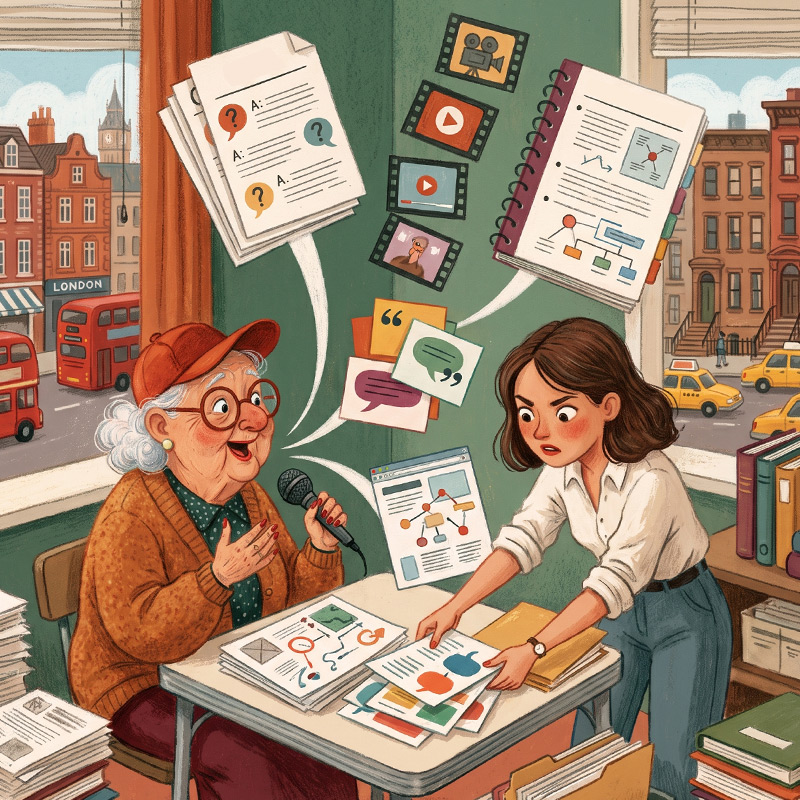
Interview one internal expert each month for 30 to 45 minutes. Do not ask them to “create content.” Ask questions they already answer for colleagues, donors, journalists and service users.
Then turn that conversation into several useful assets. Build one definitive Q&A page around the main issue. Create three short posts that challenge weak assumptions. Record two brief videos answering common questions. Pull attributable statements from the interview for future articles.
This approach turns one conversation into a small knowledge system. It also gives charity AI search tools clearer answers to discover. Recent nonprofit research from Fundraise Up illustrates why that matters: a donor can now ask an AI assistant for help choosing a nonprofit before visiting any website.
Your best answer needs to exist before that question gets asked.
AI visibility for charities should answer local questions.
London and New York City audiences rarely ask identical questions. Their laws, services, terminology and funding environments differ. Your expert pages should show that difference.
For example, a London charity could ask a program lead about local referral routes. An NYC nonprofit could interview a clinician about access barriers in the five boroughs. One central subject can produce separate answers for each market.
That local context strengthens AI search visibility without forcing your team to invent new topics every week. The recent expertise-extraction analysis makes a useful point here: organizations already possess original knowledge that competitors cannot simply copy. Your task is to capture it clearly.

AI visibility for charities can start this month.
Use this five-step routine:
- Pick one internal expert with clear subject knowledge.
- Collect ten questions that people already ask them.
- Record one focused monthly interview.
- Publish a Q&A, three answer posts and two short videos.
- Add the expert’s biography, credentials, topics and relevant internal links.
Keep the routine small enough to repeat. The urgency comes from changing discovery behavior, not from creating panic. As the Bridgespan research shows, many nonprofits know AI matters but still lack a formal path forward. A monthly expertise routine gives your team a practical starting point.
We’ve seen this work for others. Want to see it for yourself? You can Contact Us to map the first expert interview around your London or NYC priorities.
ReadTomato’s Hot Take Engine turns the expertise already inside your organization into authority people and AI systems can actually find.

Marshall Gill is a Partner at ReadTomato and a branding and marketing strategist focused on making marketing messages customers actually click. Since 2002, he has helped brands in tourism, hospitality, oil and gas, tech, and real estate turn expertise into clear, search-ready content that attracts, educates, and connects with customers.
Want a content rhythm like this built into your CRM?
Contact ReadTomato