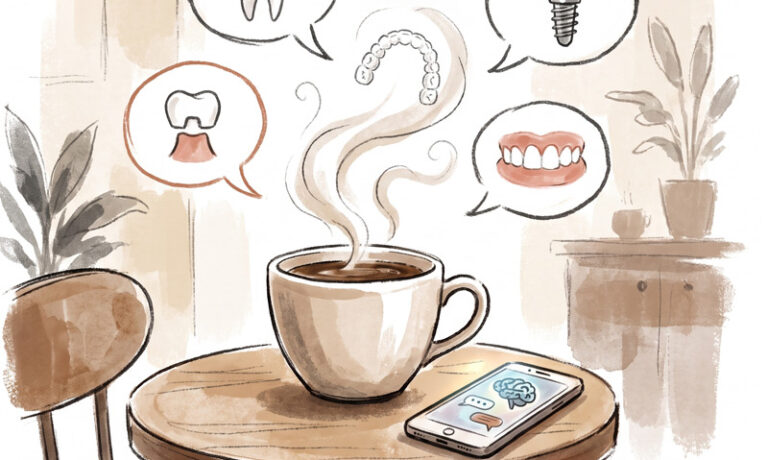
A patient asks, “Do I really need this crown?” Your dentist gives a careful 45-second answer. That answer may be your best dental marketing content of the day. A September 1 paper in the Journal of Evidence-Based Dental Practice describes shared decision-making as a core part of patient-centered dental care. Yet many practices leave that reasoning in the treatment room. Then their website publishes another broad article about crown benefits. That is backwards.
The dentist probably produces better content during patient conversations than the practice publishes online.
Dental marketing content should start with patient questions.
Every week, patients ask questions that reveal what future patients will search. They ask about implants, veneers, crowns, costs, alternatives and conflicting recommendations. These questions matter because patients rarely need another procedure definition. They need help making a decision. The American Dental Association recently stressed how much dentistry depends on professional judgment, evidence and patient trust. Your content should let people see some of that judgment before they book.
Instead of asking your marketing team, “What should we write this month?” ask, “What did the doctor explain three times this week?” That shift creates a better editorial calendar. It also uses curiosity and authority together, two principles from ReadTomato’s marketing framework. The lesson feels useful because it starts with a real concern, not a keyword spreadsheet.

Dental marketing content should preserve the dentist’s judgment.
A generic writer can explain what an implant does. That writer cannot automatically explain why your dentist prefers one option in a certain situation. The difference matters. An August 19 article from Oral Health Group described an “authority gap” between a dentist’s real clinical ability and what patients can perceive online. Chairside explanations can help close that gap because they expose reasoning, experience and philosophy.
For example, ask the doctor, “When would you recommend a bridge instead of an implant?” Then record the answer without patient information. Follow with questions about tradeoffs, timing and common misunderstandings. Keep appropriate clinical caveats. Add the dentist’s name, credentials and review date. If older website pages flatten that expertise into generic copy, Content Cleaning can help turn those pages into clearer expert-led answers.
Dental marketing content now fits how people search.
Search itself is becoming more conversational. Search Engine Journal reported on August 21 that AI Mode queries average about three times the length of traditional searches. People can now ask detailed questions instead of typing short phrases. A question like “Is a crown worth doing if the tooth does not hurt?” fits that behavior far better than “dental crowns benefits.”
Specific expertise also has a chance to travel farther. An August 18 analysis of 300 million U.S. searches found that AI citations can favor content answering the exact question over accounts with larger audiences. That finding, reported by Search Engine Journal, gives dental GEO a simple direction: publish clear answers built around real patient intent. Do not manufacture expertise with more words. Capture the expertise your doctors already use.
Dental marketing content can fuel video and search.
One strong answer does not need to become one blog post. It can become a short video, article section, FAQ and social clip. The video hook could be: “Your dentist probably created today’s best marketing content at 10:15 this morning, and nobody recorded it.” Then show the patient question, the dentist’s answer and the finished assets. ReadTomato’s Hot Take Engine is designed around that capture-and-repurpose model.
You can now measure some of this visibility too. Google said on August 31 that its generative AI Search reporting had expanded, while Search Engine Journal reported worldwide rollout of AI Search performance reports. That gives practices another reason to treat GEO as measurable content work, not a vague AI trend. Track which answer pages appear, which questions drive consultations and which topics deserve follow-up videos.

A simple dental marketing content workflow captures it.
Start small. Your team does not need another complicated content meeting. Instead, use one weekly routine and repeat it.
- Ask the dentist for three questions patients repeated that week.
- Record five-minute answers without patient-identifying information.
- Pull the clearest 30-to-60-second explanations for video.
- Build one searchable question-and-answer page around each topic.
- Add credentials, review dates, caveats and a consultation pathway.
- Track which answers bring search visibility, calls and appointments.
This approach also matches Google’s current direction. Its August 31 update for website owners says people increasingly use generative AI to find, sort and understand information. You can review Google’s guidance through its website-owner update while keeping your strategy simple: answer the real question clearly, then make the next step easy.
The best lesson is not sitting in your content calendar. It is happening chairside today. Capture that lesson while the reasoning is fresh. Preserve the doctor’s voice. Then connect useful answers to consultations. We’ve seen this work for others. Want to see it for yourself? Contact Us and see how a chairside-question workflow could fit your practice.

Rob Saxe is Senior Editor, where he oversees content creation and manages client content portfolios. He’s been an integral part of the team since 2008.
Want a content rhythm like this built into your CRM?
Contact ReadTomato