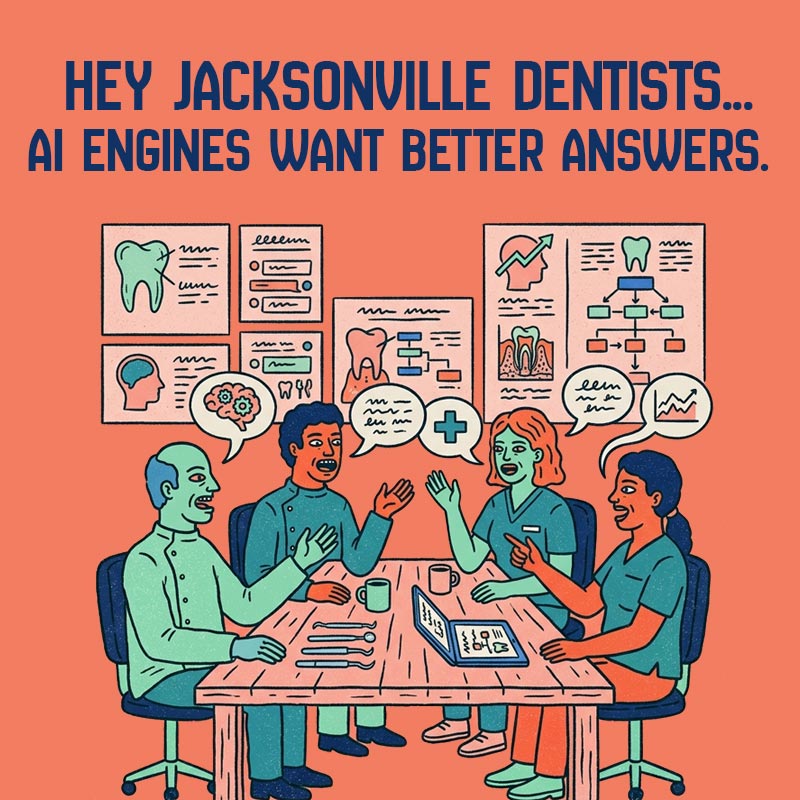
Jacksonville businesses are already changing how they think about online visibility. A local PR firm recently posted its strongest quarter in nearly 25 years. Revenue rose 28% year over year as clients reconsidered traditional search strategies, according to the Jacksonville Business Journal. For dentists, that shift raises a practical question. Is your Jacksonville dental marketing built only to rank, or can AI understand your expertise?
That difference matters because patients now have another way to research care. Instead of typing “dentist Jacksonville” and opening several websites, they can ask a detailed question. They might ask which treatment fits their situation. They can also ask what recovery involves or which provider to consider. Search Engine Journal recently described how AI assistants can narrow local searches before customers visit a website.
Jacksonville dental marketing now needs clear answers.
A new local-search study gives dental practices a reason to examine their websites. Researchers analyzed 14,472 Gemini citations across 1,487 local searches. Nearly 60% pointed directly to business websites, according to Search Engine Land. That means your website remains an important source when AI looks for local information.
Yet the study also found something less predictable. Repeated Gemini searches often produced different sources. The same top business appeared only about 7% of the time. The researchers at Steady Demand also found major differences between Gemini and ChatGPT citations. Therefore, chasing one fixed “AI ranking” may miss the larger opportunity.
Your goal should be easier to control. Give discovery systems accurate information about your dentists, treatments and Jacksonville service area. Then answer the questions patients actually ask.

Your dentists already have content AI cannot copy easily.
Think about a high-value consultation. A patient asks whether an implant makes sense. Your dentist does not respond with 600 generic words about implants. The dentist considers bone health, timing, alternatives and the patient’s goals.
That explanation contains something valuable: professional judgment.
This is where dental SEO can move beyond short keywords. Instead of publishing another broad treatment article, interview the dentist. Ask what makes someone a candidate. Ask why one option may work better than another. Ask what patients often misunderstand.
Google’s current Search documentation supports this direction. Its guidance for generative AI features stresses useful, non-commodity content alongside established SEO practices, as shown in Google Search Central’s latest documentation updates.
The lesson is simple. Your next SEO asset may already exist inside your dentist’s explanation of a treatment decision.
Local dental SEO should make Jacksonville expertise obvious.
Jacksonville’s dental market continues to attract investment. Recent commercial permit activity included a dental institute project, according to the Jacksonville Business Journal. More dental activity can mean more choices for patients. It can also increase the need for established practices to explain what makes their care different.
That explanation should appear across your website. Keep doctor information consistent. Clearly identify treatment areas. Explain where the office serves. Answer patient questions using language people understand.
This approach also helps AI search visibility because machines need usable evidence. Search Engine Journal is now teaching local businesses how to build pages that AI engines can read, trust and cite through its AI search visibility program. Clear information helps patients too, so you do not need separate content strategies for humans and machines.
AI dental content should start with real patient decisions.
Generic AI articles create volume quickly. They rarely capture what your doctors know from treating patients every day. A stronger dental content marketing process starts with conversations.
Try this simple workflow:
- Record five questions patients ask during valuable consultations.
- Have a dentist answer each question naturally.
- Turn each answer into one focused website article.
- Create a short video from the strongest explanation.
- Connect that content to the correct treatment and location pages.
This approach uses authority and education instead of empty volume. That fits the ReadTomato marketing guidance, which recommends giving useful information first to build trust and response.
ReadTomato’s Hot Take Engine can turn timely questions and doctor insights into articles and short authority clips. That helps your team publish useful expertise without asking dentists to become full-time writers.
Clean pages give good expertise a stronger foundation.
Strong answers can still struggle inside weak pages. Old treatment copy, inconsistent doctor details and thin location information can make a practice harder to interpret. A Content Cleaning audit can rebuild those pages around clearer treatment, doctor and Jacksonville signals.
The goal is not to write for robots. It is to remove ambiguity. Google, Gemini and patients should quickly understand who provides care, what you offer and where you provide it.
We’ve seen this work for others. Want to see it for yourself? Contact ReadTomato to discuss how your doctors’ everyday explanations could become useful search content.
If your Jacksonville website lists treatments but does not answer treatment decisions, start with a Content Cleaning audit. In Jacksonville’s AI-search shift, the practice that teaches best gives machines and patients more useful evidence to consider.

Marshall Gill is a Partner and a branding and marketing strategist focused on making marketing messages customers actually click. Since 2002, he has helped brands in the dental care industry, tourism and hospitality, oil and gas, tech, and real estate turn expertise into clear, search-ready content that attracts, educates, and connects with customers.
Want a content rhythm like this built into your CRM?
Contact ReadTomato